



mNo edit summary |
mNo edit summary |
||
| Line 9: | Line 9: | ||
Born in a remote village in the county of Cumberland, William Walker was only a lad when he became one of the first bandsmen at Keswick. His father, a church organist and choirmaster before meeting the Army, was the bandmaster. William himself later became bandmaster at Lancaster and then, after several years on solo cornet as deputy bandmaster at Pentre, took over leadership of that large South Wales band. | Born in a remote village in the county of Cumberland, William Walker was only a lad when he became one of the first bandsmen at Keswick. His father, a church organist and choirmaster before meeting the Army, was the bandmaster. William himself later became bandmaster at Lancaster and then, after several years on solo cornet as deputy bandmaster at Pentre, took over leadership of that large South Wales band. | ||
In April 1927 Pentre Band visited Boscombe for an Easter campaign that proved to be an outstanding success spiritually, musically and financially, and the bandmaster very much endeared himself to the corps folk. Upon his return to Wales he received letters inviting him to take over leadership of Boscombe Band. As he wanted a change for health reasons - he was probably still recovering from the sudden death of his wife in 1926 - and because his son Harold was only partly employed in the pit, owing to a coal strike, he decided to make the move and in the summer of 1927 he was commissioned as Boscombe Bandmaster. | In April 1927 Pentre Band visited Boscombe for an Easter campaign that proved to be an outstanding success spiritually, musically and financially, and the bandmaster very much endeared himself to the corps folk. Upon his return to Wales he received letters inviting him to take over leadership of Boscombe Band. As he wanted a change for health reasons - he was probably still recovering from the sudden death of his wife in 1926 - and because his son [[Harold Walker|Harold]] was only partly employed in the pit, owing to a coal strike, he decided to make the move and in the summer of 1927 he was commissioned as Boscombe Bandmaster. | ||
He soon recognised the bandsmen to be <font class="historyinlinequote">a fine lot of fellows, most of them willing to learn</font>, and set about the task of making Boscombe one of the best bands in the Salvation Army. The regular thursday night practice was supplemented by a tuesday sectional rehearsal, each night concluding with a 15 minute spiritual so that the bandsmen would be <font class="historyinlinequote">kept aware of where they were going</font>. | He soon recognised the bandsmen to be <font class="historyinlinequote">a fine lot of fellows, most of them willing to learn</font>, and set about the task of making Boscombe one of the best bands in the Salvation Army. The regular thursday night practice was supplemented by a tuesday sectional rehearsal, each night concluding with a 15 minute spiritual so that the bandsmen would be <font class="historyinlinequote">kept aware of where they were going</font>. | ||
| Line 49: | Line 49: | ||
[[New Instruments]] | [[New Instruments]] | ||
</div> | </div> | ||
<div class="wikilinks"> | <div class="wikilinks"> | ||
[[Weekend Campaigns]] | [[Weekend Campaigns]] | ||
</div> | </div> | ||
<div class="wikilinks"> | <div class="wikilinks"> | ||
[[Harold Walker]] | [[Harold Walker]] | ||
</div> | </div> | ||
<div class="wikilinks"> | <div class="wikilinks"> | ||
[[Queen's Hall 1934]] | [[Queen's Hall 1934]] | ||
</div> | </div> | ||
<div class="wikilinks"> | <div class="wikilinks"> | ||
[[Influence of Adjutant Wingett]] | [[Influence of Adjutant Wingett]] | ||
</div> | </div> | ||
<div class="wikilinks"> | <div class="wikilinks"> | ||
[[First Broadcast]] | [[First Broadcast]] | ||
</div> | </div> | ||
<div class="wikilinks"> | <div class="wikilinks"> | ||
[[Retirement of Bandmaster Walker]] | [[Retirement of Bandmaster Walker]] | ||
</div> | </div> | ||
Revision as of 00:45, 7 November 2019

1927 to 1938
Born in a remote village in the county of Cumberland, William Walker was only a lad when he became one of the first bandsmen at Keswick. His father, a church organist and choirmaster before meeting the Army, was the bandmaster. William himself later became bandmaster at Lancaster and then, after several years on solo cornet as deputy bandmaster at Pentre, took over leadership of that large South Wales band.
In April 1927 Pentre Band visited Boscombe for an Easter campaign that proved to be an outstanding success spiritually, musically and financially, and the bandmaster very much endeared himself to the corps folk. Upon his return to Wales he received letters inviting him to take over leadership of Boscombe Band. As he wanted a change for health reasons - he was probably still recovering from the sudden death of his wife in 1926 - and because his son Harold was only partly employed in the pit, owing to a coal strike, he decided to make the move and in the summer of 1927 he was commissioned as Boscombe Bandmaster.
He soon recognised the bandsmen to be a fine lot of fellows, most of them willing to learn, and set about the task of making Boscombe one of the best bands in the Salvation Army. The regular thursday night practice was supplemented by a tuesday sectional rehearsal, each night concluding with a 15 minute spiritual so that the bandsmen would be kept aware of where they were going.
A dour, stern-faced, disciplinarian, the bandmaster somewhat frightened the newer band members and they did not all appreciate the abrupt, straight talking manner which once led him to say to a trombone player
If I had a tone like that I'd take it home and jump on it
Nevertheless they soon warmed to a character who proved himself to be a deeply religious man and a gracious Christian. Believing in putting first things first, the musical advancement of the band would have mattered little to him if it were not accompanied by spiritual advancement. He took as his motto for the band
Study to show thyself approved unto God, a workman that needeth not be ashamed
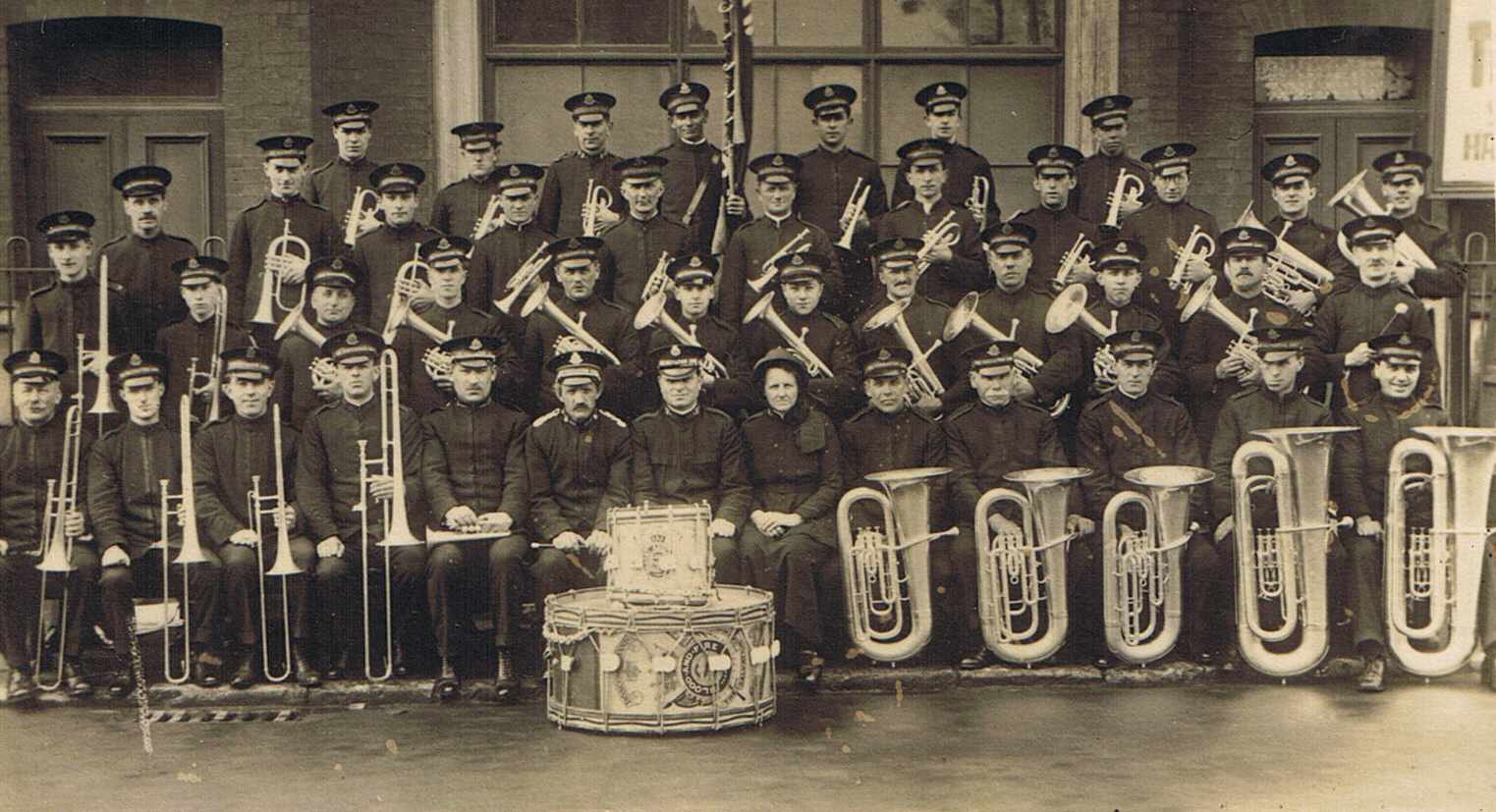
Numbering between 36 and 40, the band produced a sound described as full, but not loud, with Elijah and brass arrangements of other classical music providing the backbone for its musical development. Rarely using a baton to conduct the band, the bandmaster relied instead upon the expressiveness of his hands. When it came to the singing, for which the band was renowned, he became very emotionally involved, especially if the piece concerned was, Jerusalem for which he had written words and melody.