



mNo edit summary |
mNo edit summary |
||
| Line 20: | Line 20: | ||
</div> | </div> | ||
<div class="wikilinks"> | <div class="wikilinks"> | ||
[[File:Bm antell | [[File:Bm antell.jpg|50px|link=Gilbert Antell|middle|Bandmaster Gilbert Antell]] | ||
</div> | </div> | ||
Latest revision as of 16:03, 1 January 2020
Band activities at Boscombe regularly included Sunday night openairs at Chessel Avenue followed by a grand march back to the hail. Pavements would he lined with crowds 5 or 6 deep, and police held up trams to allow free procession. On Winter evenings it has been known for the band to march in silence with their musical instruments frozen up. Regular Sunday afternoon programmes were given in Dorchester prison, and one annual highlight for the band was a festival in Bournemouth town hall in which all the local SA bands participated.
An instrument silver plating scheme was concluded on December 21st 1919 when the band was presented with £200. In the Sunday morning meeting on March 14th 1920 Major Cecil Rees consecrated a full set of new silver plated instruments. He also dedicated the instruments in the afternoon festival, which was attended by a capacity crowd at Boscombe Hippodrome. The Mayor of Bournemouth presided and special guests included Mr. Dan Godfrey, musical director to the Corporation of Bournemouth, and reckoned to be one of the greatest living authorities on band playing.
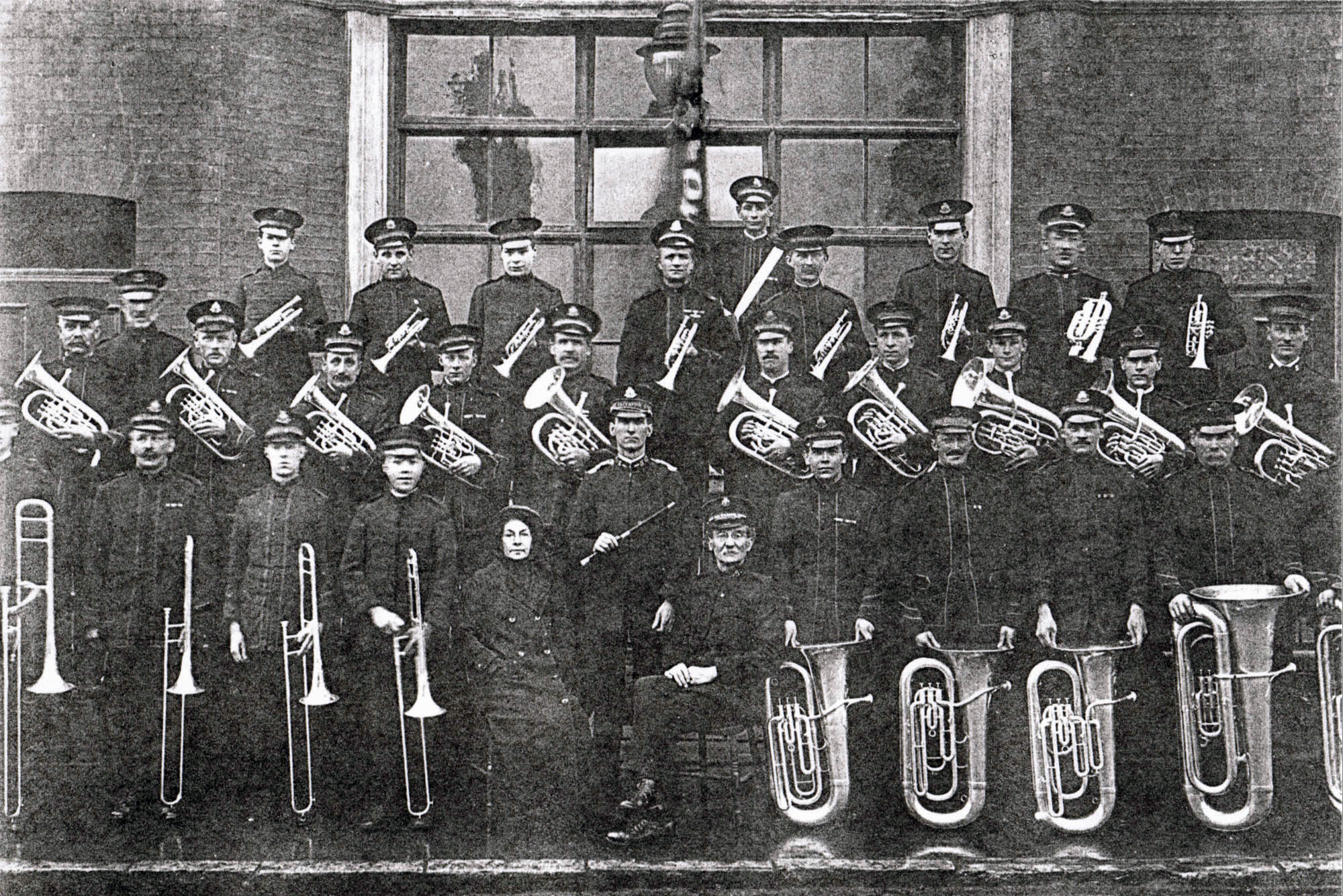
At 9am on a damp Good Friday morning, the bandsmen proudly assembled in front of the citadel for a photograph. Many of these men went on to become honoured and respected veterans of the band, with long service being recorded by Alf Clayton (52 years), William Tubbs (41 yrs), Felix Glanville (41 yrs) and retired Band-Sergeant Hawkins. Harry Cutler (sr) completed half a century with the band and was to be the first of four generations of Cutlers to see service with it. Frank Antell, his companion on Bb bass, was responsible for providing the first and last notes of his brother Gilbert's favourite selection Eventide and went on himself to complete over 50 years on the band's bass section.
Renowned for the sincerity of his Christian witness and his friendly, cheerful disposition, trombone player Charlie Gregory was one of the band's most interesting characters. Before becoming a taxi-driver he used to drive a hansom-cab through the gaslit streets of London, where General William Booth was one of his regular fares. Instantly recognizing him as one of my boys the founder would advise him of the quickest route from Kings Cross to Queen Victoria Street before adding the admonition And don't go round the corners on one wheel. Another memorable fare was a quiet, inoffensive, bespectacled doctor, and a good looking cockney girl. Only later did Charlie realise they were the notorious Dr. Crippen and Ethel le Neve, for whose love Crippen murdered his wife.
On at least one occasion the band went away for a weekend, visiting the corps of Alton during the August bank holiday of 1924. Travelling in a charabanc that they nicknamed the 'egg boiler', they had only reached Holmsley in the New Forest when the inevitable happened and the radiator boiled over. While waiting for the vehicle to be repaired the bandsmen did not sit idly by, but enjoyed a game of cricket. Inevitably the evening festival started two hours late, but the rest of the weekend did pass without further calamity.
